INDONESIA'S BIGGEST STONE MONSTER WAS BURIED IN A KEDIRI RICE FIELD FOR 1,000 YEARS
Archaeologists found Indonesia's largest makara sculptures at Candi Adan-Adan in Kediri — a 1,000-year-old temple that rewrites Javanese history.
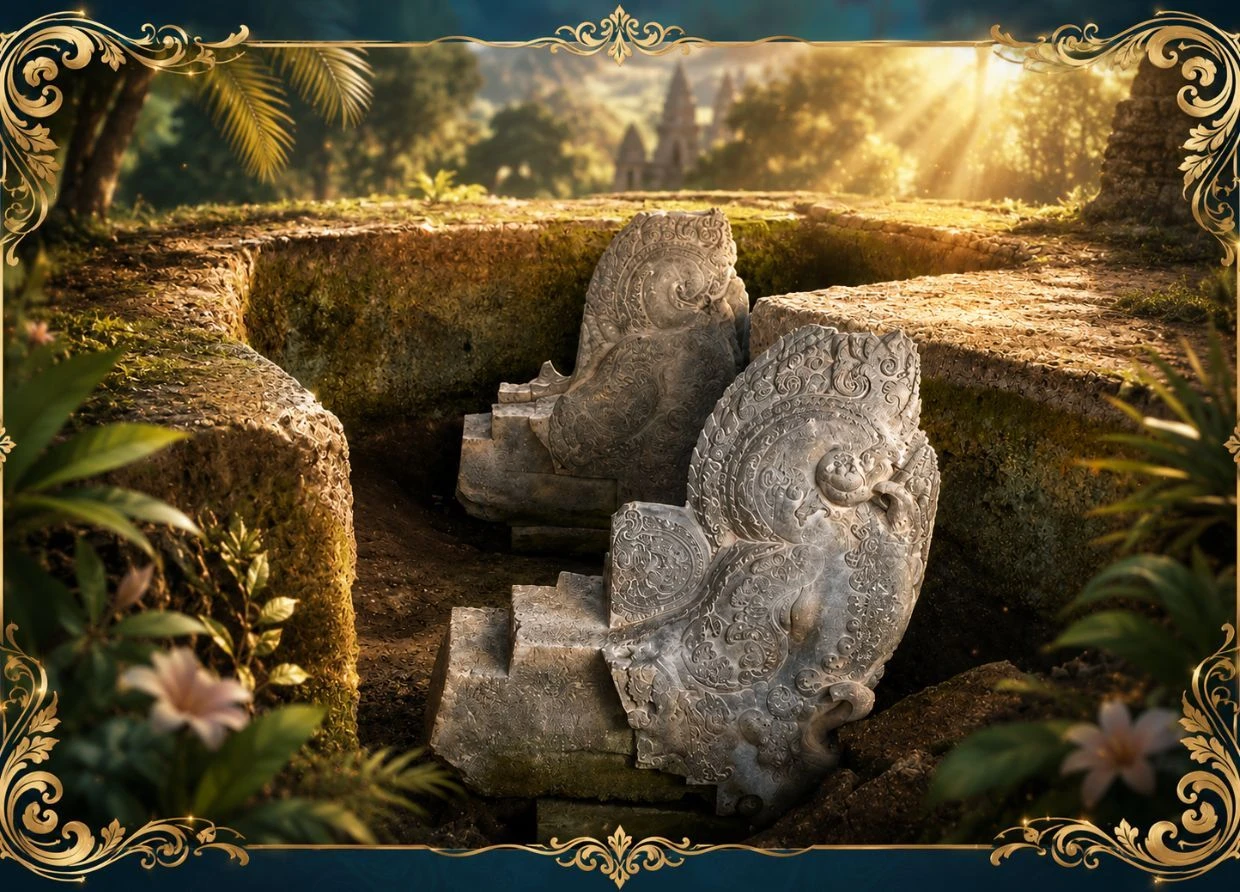



Somewhere under a field in Kediri, a stone creature with an elephant's trunk, a fish's gills, a snake's body, and a human face had been waiting. For roughly a thousand years, it sat in the dark — until archaeologists from Indonesia's National Archaeological Research Center (Puslit Arkenas) started digging.
What they pulled out of the ground at Candi Adan-Adan wasn't just old. It was record-breaking.
What Is a Makara - and Why Does It Matter ?
A makara is a mythical guardian creature from Hindu-Buddhist cosmology, and in ancient Java, it was placed at temple entrances to ward off evil and mark sacred thresholds. Think of it as the ancient world's version of a security system — except carved from andesite stone and built to last a millennium.
The makara found at Candi Adan-Adan in Kediri are the largest of their kind ever recorded in Indonesia. They depict a composite beast — part elephant, part fish, part snake, part human — and what makes them truly unusual is that the left and right makara are not identical. The figures carved inside each creature's open mouth, the front sculptures, and the back details are all different from one another — something rare in ancient Javanese temple art.
A Temple That Bridges Two Eras
Candi Adan-Adan sits at a historically critical moment. Researchers identify it as an art style of the Kadiri period — a transitional era between the Ancient Matarām kingdom and the Siŋhasāri kingdom. In simple terms: this temple is a cultural bridge between Central Javanese traditions and the later East Javanese style that would eventually produce Majapahit.
Based on ceramic fragments found at the site — including Chinese ceramics from the Song Dynasty (10th–13th century) and Yuan Dynasty pieces — researchers estimate the temple was built in the 10th century and abandoned by the 14th century.
That's 400 years of active use, then centuries of silence.
Rediscovered, Then Forgotten, Then Found Again
Dutch colonial records from 1908, documented by researcher Knebel, noted that Candi Adan-Adan had already been buried for hundreds of years when it was first officially recorded. Modern excavations by Puslit Arkenas in 2018–2019 finally uncovered the temple structure in full — including the stone kala head (a fierce face above doorways) and the monumental makara pair.
Until these excavations, only two architectural structures — Candi Gurah and Candi Tondowongso — were confidently attributed to the Kediri period. Adan-Adan is now the third confirmed Kediri-era temple.
That makes it a big deal. Not just for archaeologists, but for anyone trying to understand how Indonesian civilisation actually developed.
Why You Should Care About a Stone Creature in Kediri
Indonesia has over 800 registered ancient temple sites. Most people only know Borobudur and Prambanan. But the real story of Javanese civilisation — the messy, transitional, 400-year-long story — is buried in places like Adan-Adan, waiting to be told.
The counterintuitive truth? Some of the most important archaeological sites in Southeast Asia don't have ticket booths. They have tarps and bamboo scaffolding, as seen in the viral TikTok video shared by @history_piece — and that's exactly what an active dig looks like.