INDONESIA FLIPS THE SCRIPT AT VENICE BIENNALE 2026 WITH "PRINTING THE UNPRINTED"
Indonesia's Venice Biennale 2026 pavilion "Printing the Unprinted" imagines Batak sailors who discovered Europe — told through etching by 7 artists.



Five hundred years ago, according to every history book you've ever read, European sailors were the ones doing the discovering. Indonesia's pavilion at Venice Biennale 2026 wants to know: what if that story was always missing half its characters?
That's the premise behind "Printing the Unprinted" — Indonesia's official entry at the world's most prestigious contemporary art fair. Seven printmakers, spanning generations, bring to life a fictional manuscript about Batak sailors who crossed oceans, reached Europe, and left no trace in the official record. The medium they chose — etsa, or etching — is deliberate. These are prints of things that were never printed. Archives of things that were never archived.
What is "Printing the Unprinted" at Venice Biennale 2026 ?
"Printing the Unprinted" is Indonesia's pavilion contribution to Venice Biennale 2026, presented by seven Indonesian visual artists working in the printmaking tradition. The exhibition is built around a speculative fiction framework: a 14-year voyage by Batak sailors that "disappeared" from world history. The entire narrative is told through the eyes of Datu Na Tolu Hamonangan, an imaginary archivist from Pusuk Buhit — the sacred mountain on the banks of Lake Toba — who documented everything the world forgot.
What Does Each Artist Bring to the Exhibition?
Each of the seven artists takes a different chapter of this imagined history.
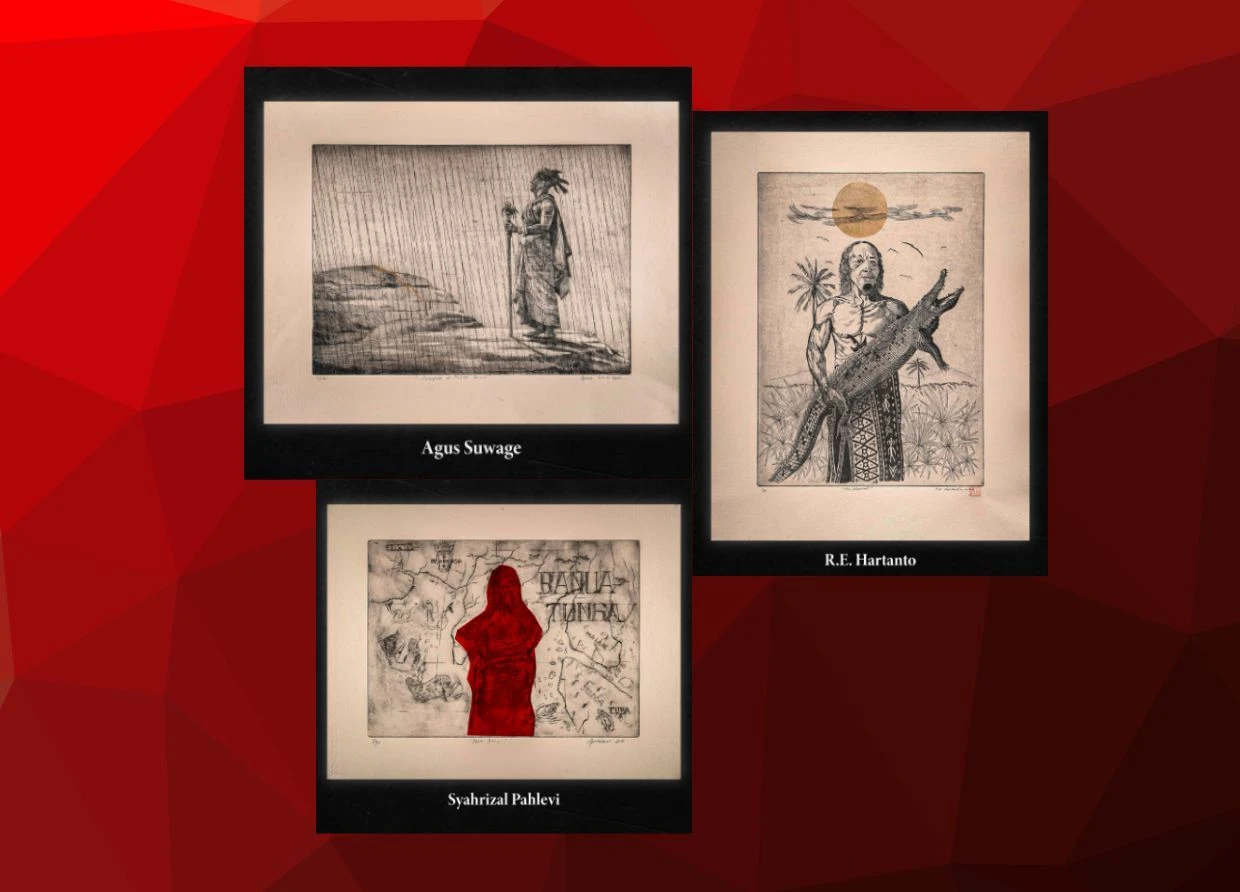
Agus Suwage opens the story at its spiritual root — the sacred mandate of Raja Uti, a departure that began not at a harbor but in the openness of heart. His etching shows a lone figure standing on rock under streaks of rain, staff in hand, already mid-journey before the sea even appears.
R.E. Hartanto renders Datu Na Tolu Hamonangan himself — muscular, scarred, holding a crocodile under one arm beneath a burning sun. It's the Batak archivist as action figure, myth made flesh.
Syahrizal Pahlevi does something quietly radical: he redraws the world map with Lake Toba at the center. Europe shrinks to a small peninsula at the edge of everything. It's a gentle slap at five centuries of Eurocentric cartography — and the kind of image you don't forget.
Mariam Sofrina captures the strangest scene of all: Batak sailors tasting wheat bread at a Venetian market while European merchants stare, transfixed, at their tattoos and hand-woven ulos cloth. Two civilizations, equally bewildered by each other. Brotherhood built on mutual confusion.
Theresia Agustina Sitompul depicts the pre-voyage ritual of martonun — reading chicken entrails before setting sail — a reminder that scientific navigation and spiritual navigation were never opposites. Nurdian Ichsan rounds out the narrative with scenes of technology exchange: Batak knowledge meeting European glass-making and clockwork, the two worlds trading ideas as equals.
The air in the pavilion, according to those who've previewed it, carries the weight of something recovered — like opening a chest that shouldn't have been locked.
Why Printmaking — and Why Now?
Etching is one of the oldest Western print technologies — introduced to the world by European masters. Using it to tell a story that inverts European discovery mythology is a choice that's almost too elegant to be accidental. The medium is the message: these artists are printing their own history onto Europe's own tools.
The timing matters too. In a post-colonial cultural moment where museums are returning looted artifacts and nations are demanding their narratives back, Indonesia isn't waiting. It's not petitioning. It's just — printing.