
SWITZERLAND IS STILL #1 — AND INDONESIA JUST RANKED 62ND
The US News Best Countries 2026 ranking is out, and the results reveal exactly what separates a great nation from a struggling one.



Switzerland Has Been #1 for Years. Here's Why That's Actually Hard to Argue With.
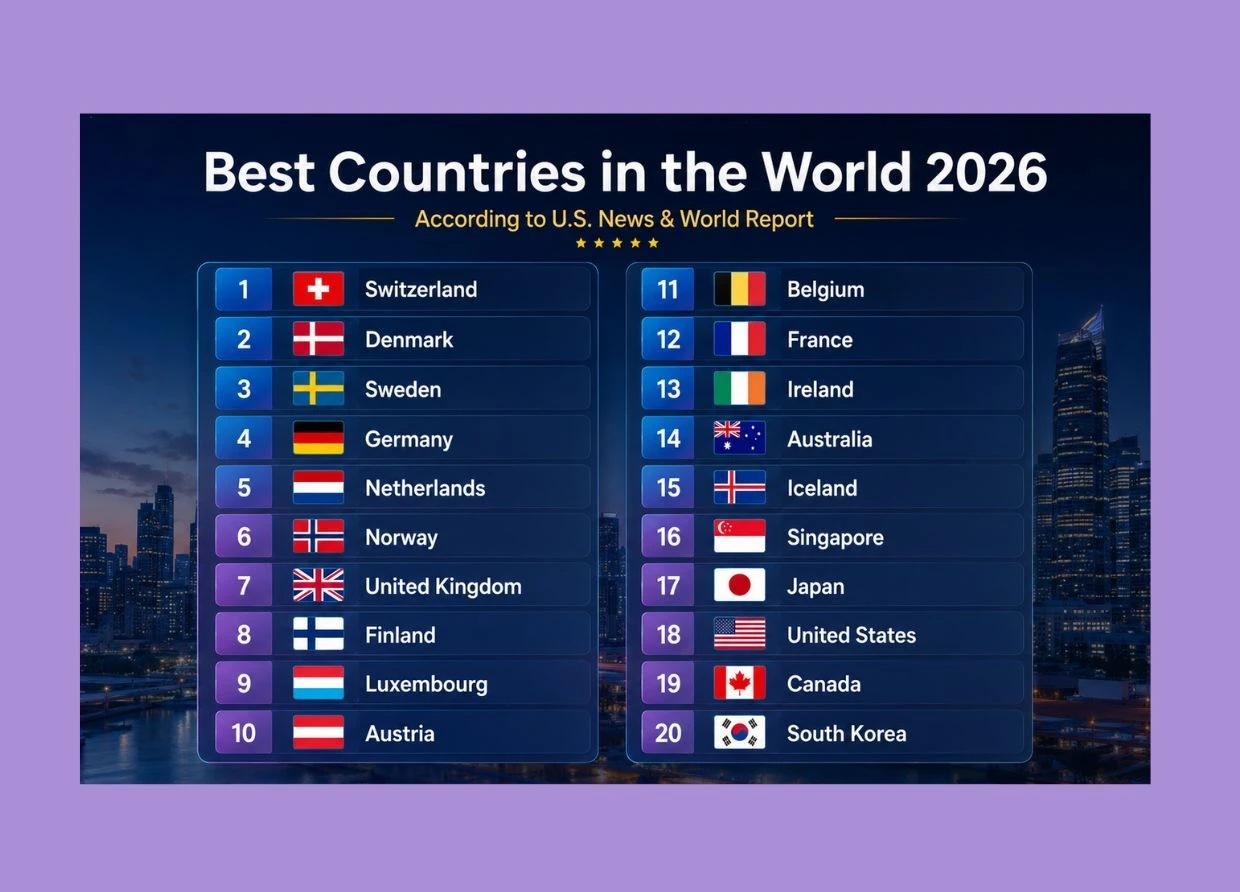
Imagine a country where the trains run on time, the air is clean enough to taste, the government actually does what it says it will, and your salary goes far enough to enjoy the mountains on weekends. That's Switzerland in 2026 — and according to US News & World Report's annual Best Countries ranking, it's the best place on Earth to live, with a score of 78.8 out of 100.
The ranking doesn't just measure GDP or Instagram-worthy scenery. US News evaluates countries across eight rigorous performance metrics: public health, culture and tourism, economic development, governance, health systems, infrastructure, natural environment, and opportunity. Switzerland scores near the top in almost all of them.
What is the US News Best Countries 2026 ranking? It is an annual index published by US News & World Report that scores countries based on eight weighted performance categories including governance, public health, economic development, infrastructure, and opportunity. The 2026 edition ranks Switzerland first with a score of 78.8, followed by Denmark at 77.2 and Sweden at 76.1. Countries are assessed using survey data and publicly available global metrics.
Who Made the Top 10- And What Do They Have in Common ?
The top ten reads almost like a map of Northern Europe: Switzerland (78.8), Denmark (77.2), Sweden (76.1), Germany (75.5), the Netherlands (75.0), Norway (74.2), the United Kingdom (73.3), Finland (73.2), Luxembourg (72.9), and Austria (72.7).
Notice anything? Eight out of ten countries are in Western or Northern Europe. The one thing they share isn't oil wealth or population size — it's institutional trust. Citizens in these countries consistently report believing their governments, courts, and public services actually function. That trust, built over generations, shows up in every metric from infant mortality rates to startup density.
"Strong institutions don't just support economies — they are the economy. Everything else flows from governance." — Urban policy analyst, as noted in the World Economic Forum's 2025 Competitiveness Report.
Where Does Indonesia Stand — And What Does a Score of 49.3 Actually Mean?
Indonesia lands at rank 62 with a score of 49.3 — a 29.5-point gap from Switzerland. That number isn't a verdict on the country; it's a diagnosis. Indonesia scores higher than many of its Southeast Asian neighbors in areas like natural environment and cultural richness, but lags in governance consistency, infrastructure quality, and opportunity access.
The surprising part: Indonesia's score in culture and tourism likely keeps it competitive in this range. The country has the landscape, the diversity, and the soft power — it's the institutional scaffolding that still needs catching up.
Here's the counterintuitive insight worth sharing: countries with smaller populations often rank higher — Luxembourg has under 700,000 people and scores 72.9. Scale creates complexity, and complexity makes governance harder. Managing 280 million people across 17,000 islands is a fundamentally different challenge than running a compact Northern European nation.
How Much Does Ranking Change Year to Year?
The top tier tends to be sticky. Switzerland, Denmark, and Sweden have traded the top three positions for the past several years. Countries in the middle tier — roughly ranks 40 to 80 — show more movement, as infrastructure investment and governance reforms can shift scores meaningfully within two to three years. Indonesia has the demographic dividend and natural resources to move up, but ranking gains require policy consistency over election cycles, not just single-term wins.