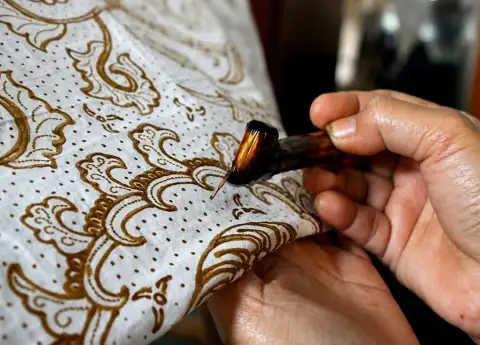
THE BLUE IN NAPOLEON'S ARMY CAME FROM JAVA'S FORCED LABOR FIELDS
The iconic blue of Napoleon's army uniform came from Javanese indigo fields. Here's the forgotten colonial history behind Europe's most famous military color.




Walk into any museum showing 19th-century European battle paintings and one thing hits you before the cannon smoke or the cavalry charges: a sea of blue. Not sky blue. Not the washed-out denim kind. Deep, saturated, almost violent blue — the kind that doesn't fade under rain, mud, or blood.
That blue came from Java.
What Is Java Indigo - and Why Did Europe Need It?
Before synthetic dyes existed, blue was the most expensive and unstable color in the global textile industry. The only reliable source of a deep, lasting blue was Indigofera tinctoria — a flowering plant that, when grown in Java's specific soil and climate, produced a pigment of unmatched intensity and durability.
Javanese indigo wasn't just blue. It was the best blue in the world: the most concentrated, the most colorfast, resistant to equatorial heat, tropical rain, and — critically for military buyers — the chaos of a battlefield. Napoleon's forces wore it. Prussian infantry wore it. Armies from one end of Europe to the other wore it.
The color became synonymous with power, national identity, and military authority. No one asked where it came from.
How the Dutch Colonial System Extracted It
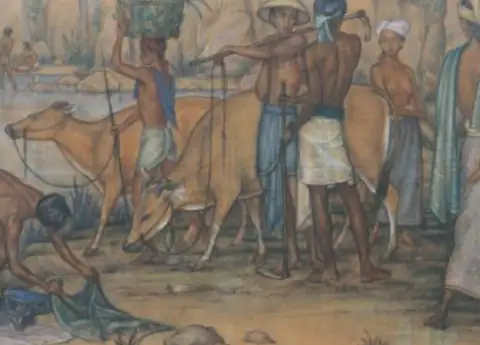
In 1830, the Dutch colonial government introduced the Cultuurstelsel — known in Indonesian as Tanam Paksa, or the Forced Cultivation System. Every Javanese farmer was required to dedicate one-fifth of their land, or 66 working days per year, to growing export crops chosen by the colonial administration. Indigo was one of them.
The process was brutal in its precision. Indigo leaves were soaked in enormous vats, manually agitated for hours to trigger oxidation, then allowed to settle into a thick blue sludge. That sludge was dried into hard crystalline blocks, loaded onto ships bound for Amsterdam, London, and Hamburg — thousands of tons every year.
(The yields weren't for the farmers. They went to the Dutch royal treasury and Europe's booming textile industry.)
The farmers who grew it, processed it, and carried it to the docks never benefited from it. Their knowledge — built over generations of agricultural practice, of understanding exactly when to harvest, how long to soak, how to read the fermentation — was the intellectual foundation of an industry worth millions. That knowledge was exploited at a scale no one had seen before.
The Counterintuitive Part History Books Skip
Here's what rarely makes it into European military history: the ancestral Javanese farmers were present at Waterloo, at Austerlitz, at every major battle of the 19th century. Not as soldiers. Not as witnesses. They were on the backs of every soldier — literally dyed into the fabric.
Their labor, their land, and their traditional agricultural knowledge traveled to European battlefields and never came home. They marched under Napoleon's name without anyone recording theirs.
The blue that symbolized European imperial power was produced by the very people that imperial power was crushing.