INSIDE FLESH & BONES: HOW HUMANS LEARNED TO SEE SELVES
Inside Flesh & Bones at ArtScience Museum explores 500 years of anatomy, uniting Eastern and Western traditions. Here’s what to know before you go.
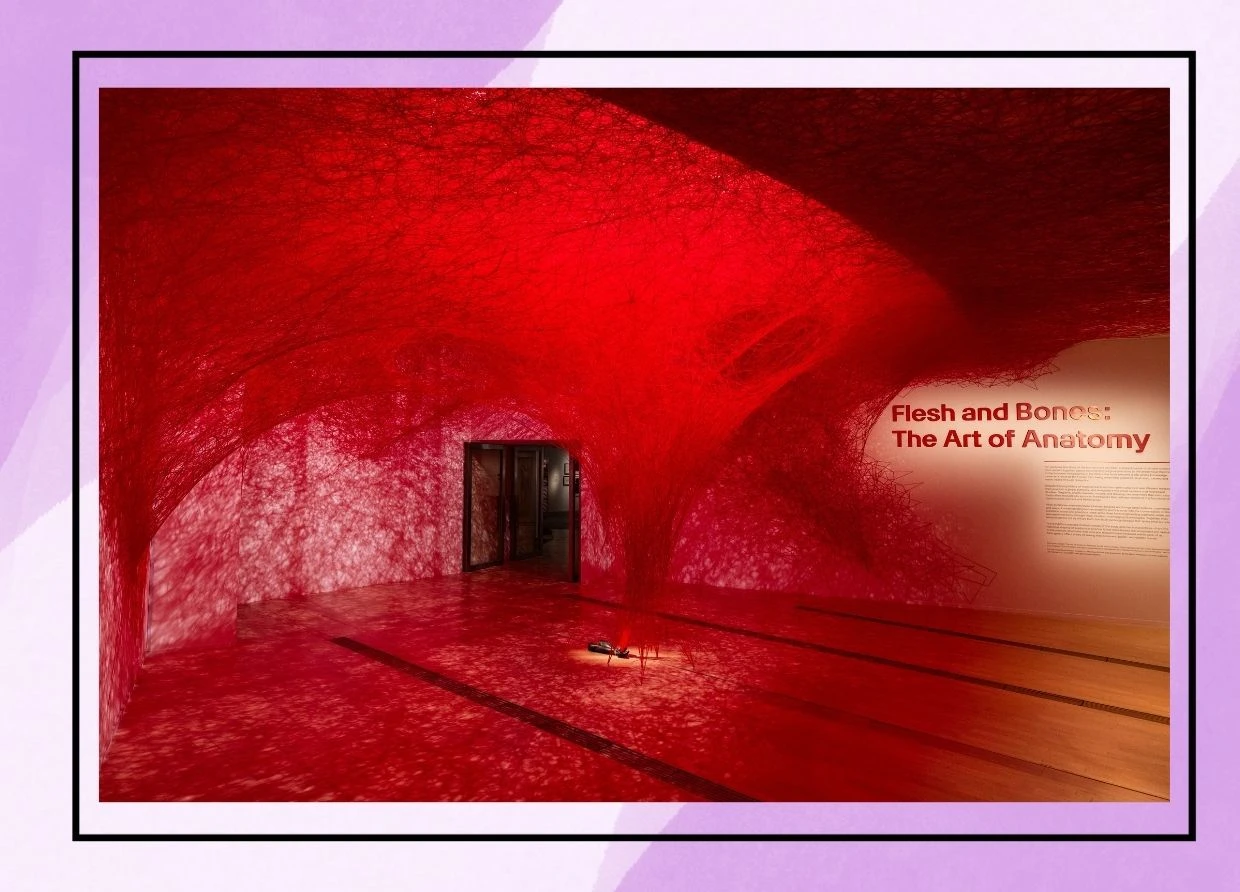





Red thread fills the room like a circulatory system that has escaped the body. That is the first thing you see walking into Flesh and Bones: The Art of Anatomy — a massive, site-specific installation by Japanese artist Chiharu Shiota that turns the entrance of ArtScience Museum into something between a lung and a cathedral.
It is a bold opening move. And it signals that this is not a science textbook on a wall.
What is Flesh and Bones: The Art of Anatomy?
Flesh and Bones: The Art of Anatomy is a major exhibition at ArtScience Museum, Marina Bay Sands, Singapore, running from 21 March to 16 August 2026. It brings together over 160 artefacts and artworks tracing how the human body has been studied, imagined and represented across cultures and centuries. Admission is via ArtScience Museum's standard ticketing. The exhibition was originally curated by Dr Monique Kornell for the Getty Research Institute in Los Angeles in 2022, and has been significantly expanded and reimagined for Singapore.
This new version adds 33 contemporary artworks, Asian medical traditions, and stories rarely told in Western anatomy history — making it a genuinely different experience from the Getty original.
Why does this exhibition matter right now?
Here is the counterintuitive thing: anatomy, one of the oldest scientific disciplines in human history, turns out to look completely different depending on where in the world you are standing. Western anatomy built its visual language through large-scale print engravings — like the life-sized illustrations by Italian artist Antonio Cattani, produced in the late 18th century and never before shown in Singapore. They are extraordinary: muscular figures, posed like sculptures, with skin peeled back to reveal a machine of extraordinary precision.
Placed right beside them are works by Hong Kong-based artist Angela Su, whose figures are anatomically precise but speculative — bodies that could be upgraded, hybridised, or questioned. The contrast is the whole point.
What makes the Singapore version different from the original?
ArtScience Museum built an entire gallery around Traditional Chinese Medicine — a discipline that developed in parallel with Western anatomy but understands the body as a network of relationships and energy flows, not just physical structure. Over 40 items are on loan from the Singapore College of Traditional Chinese Medicine, spanning ancient texts, instruments, scrolls and diagrams.
There are also 20 actual human specimens: 15 pathological specimens from NTU Singapore's Lee Kong Chian School of Medicine, and five plastinated specimens from the Institute for Plastination in Germany. These are typically used for medical education, and they are presented here alongside the Silent Mentor programme — a tradition from Taiwan where body donors are honoured as first patients and teachers. It is genuinely moving, not clinical.
What are the must-see pieces inside the exhibition?
Beyond Shiota's entrance installation, the centrepiece of the show is Evolver (2022) by London collective Marshmallow Laser Feast — a large-scale audiovisual work that takes you inside the human body, following the path of oxygen through lungs. It begins with a guided meditation narrated by Cate Blanchett, scored by Jonny Greenwood of Radiohead and Icelandic composer Jóhann Jóhannsson. There is a VR version too, at the museum's dedicated VR Gallery.
Southeast Asian voices are also present: Thai artists Araya Rasdjarmrearnsook, Pinaree Sanpitak, and Natee Utarit; and Singaporeans Yanyun Chen, Amanda Heng, Kray Chen, Woong Soak Teng, and Solamalay Namasivayam.
Is Flesh and Bones worth visiting?
If you have ever looked at a medical diagram and felt nothing, this exhibition is the antidote. It puts the science back inside the body — messy, cultural, contested, and human. Timed to mark ArtScience Museum's 15th anniversary, it is arguably the most ambitious exhibition the museum has staged. Give it two hours, at minimum.