THE COUNTRY WITH 840 LANGUAGES — AND WHY INDONESIA IS SECOND
Papua New Guinea tops the world with 840 living languages in 2024. See why Indonesia ranks second and what the full global list reveals about linguistic diversity.


A tiny island nation in the Pacific holds a record most people have never heard of. Here's what the numbers really mean.
Somewhere in the highlands of Papua New Guinea, two villages separated by a single mountain ridge speak languages so different they cannot understand each other at all. This is not a metaphor. It is how 840 living languages came to exist in a country roughly the size of California.
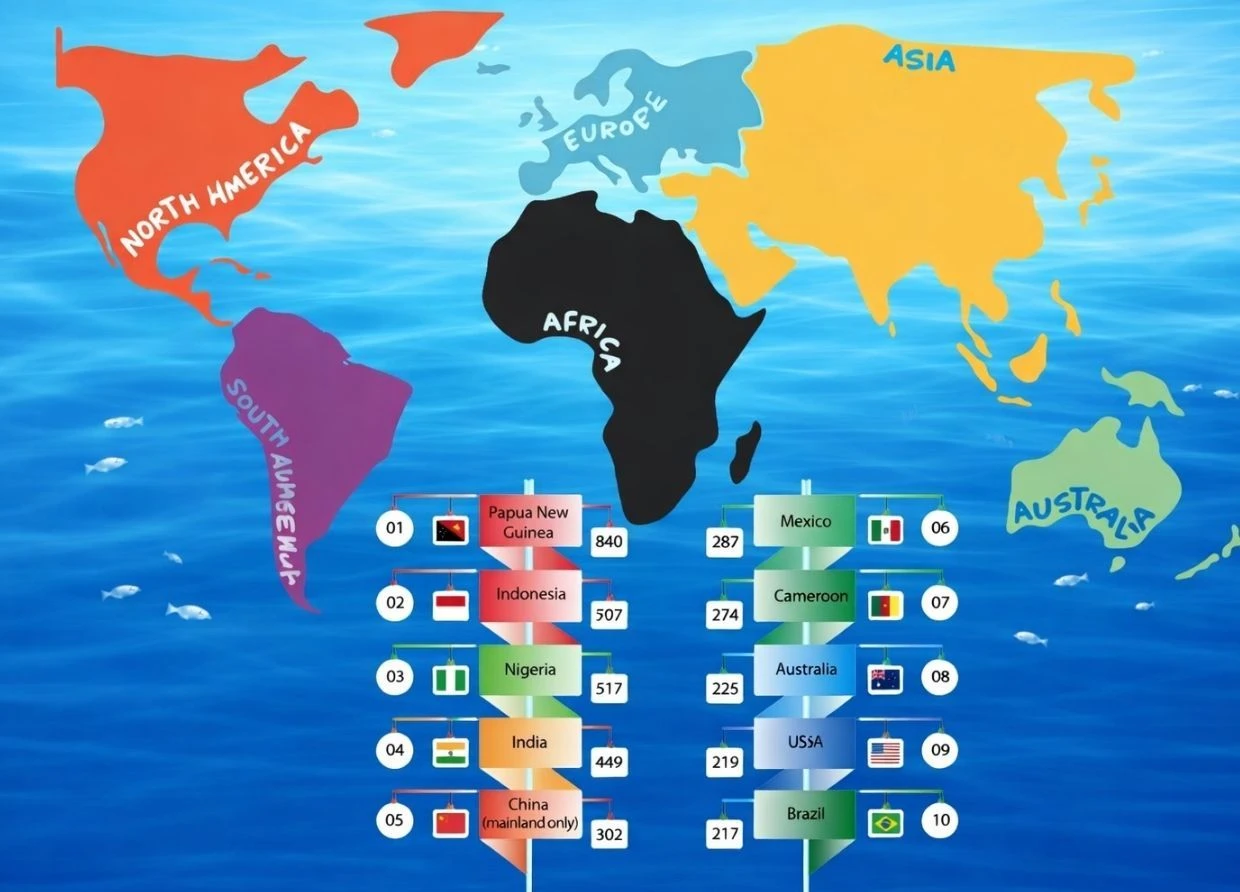
According to data from SIL International (2024), Papua New Guinea holds the top spot globally for the number of living languages — nearly 12% of the world's roughly 7,000 languages packed into one country. Indonesia follows in second place with 709, and Nigeria rounds out the top three at 532.
What does "living languages" actually mean?
A living language — sometimes called a vernacular language — is one that a community still uses daily as a primary means of communication, passed from parents to children. It is distinct from endangered or dormant languages, which are no longer learned naturally by a new generation. SIL International, the global body that tracks linguistic data through its Ethnologue database, defines a living language as one with at least one known first-language speaker. The 2024 dataset lists 7,168 living languages across 194 countries.
Why does Papua New Guinea have so many?
The short answer: geography and time. Papua New Guinea's rugged mountains, dense rainforests, and thousands of isolated valleys meant communities lived apart for tens of thousands of years. With no shared trade routes or centralised kingdoms forcing a common tongue, each group developed its own language independently. The result is extraordinary — villages just 30 kilometres apart can be mutually unintelligible.
It also means the country is a living archive of human linguistic history, with some languages spoken by fewer than 500 people.
Why is Indonesia's position surprising?
Here is the counterintuitive part: Indonesia has Bahasa Indonesia as a national language spoken by over 270 million people — yet it still ranks second globally for linguistic diversity. That is because Bahasa is a unifying overlay, not a replacement. Underneath it, communities across Sulawesi, Kalimantan, Maluku, and Papua speak Javanese, Sundanese, Bugis, Minangkabau, Balinese, and hundreds of others at home.
Walk through a traditional market in Makassar or Ambon and you will hear at least three languages before you reach the second stall. That layered soundscape is not confusion — it is the texture of a nation held together by one shared language while thousands of others quietly breathe beneath it.
Where does the rest of the list stand?
Nigeria (532), India (459), and the United States (335) round out the top five. The U.S. ranking surprises most people — it reflects hundreds of Indigenous languages still spoken across North America, not immigrant languages. Australia (319), China (305), and Mexico (292) follow. The Philippines ranks 13th with 191 languages, and Malaysia 15th with 144 — both reflecting archipelago geographies similar to Indonesia's.