
THE WORLD ECONOMIC FORUM JUST TOLD US WHICH JOBS SURVIVE 2030 AND WHICH DON'T
WEF's Future of Jobs Report 2025 says 170M jobs will be created and 92M lost by 2030. Here's what that actually means for you.






Somewhere in Geneva, a room full of executives representing 14 million workers just answered one blunt question: what does your company actually need from a human being in five years? The answers became the Future of Jobs Report 2025, and the headline number is the kind that stops your scroll by 2030, 92 million jobs will disappear.
The Future of Jobs Report 2025 is published by the World Economic Forum (WEF), the Geneva-based organization best known for its Davos summit. Released in January 2025, it's built from a survey of over 1,000 employers across 55 economies and 22 industries. The core finding: by 2030, 170 million new jobs will be created and 92 million will be displaced, a net gain of 78 million but nearly 4 in 10 skills workers use today will need to change.
At a glance:
- 170 million new jobs projected globally by 2030
- 92 million jobs displaced by the same date
- 39% of core job skills expected to change within five years
- 1,000+ employers surveyed, representing 14 million workers across 55 economies
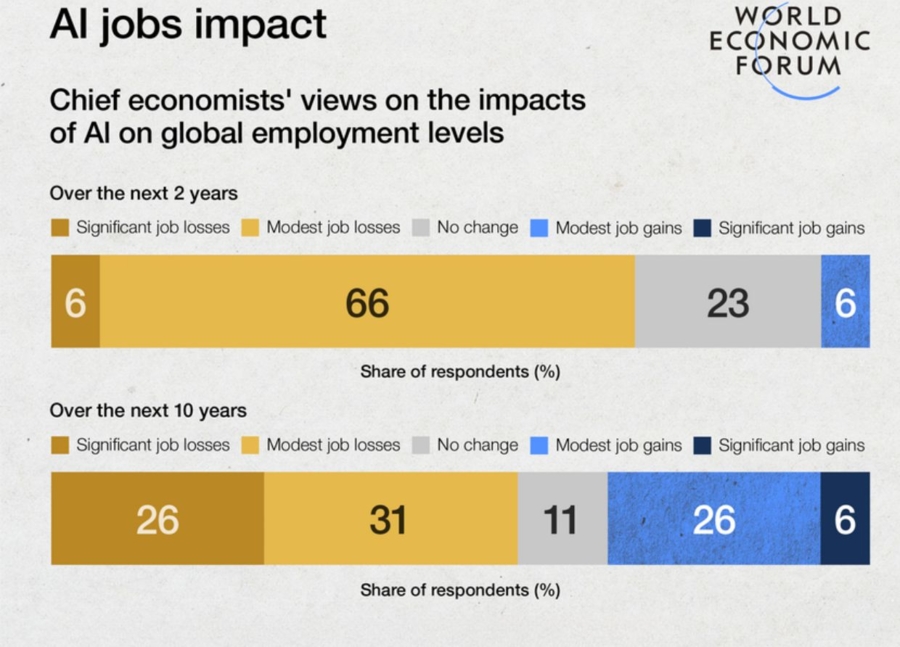
Credit : World Economic Forum (2026). Chief Economists Outlook : January 2026
What Is the Future of Job Report 2025, Really?
Think of it less as a doomsday forecast and more as a workforce weather map. Every two years, the WEF asks the world's largest employers what's actually changing inside their companies not what pundits predict, but what HR departments are budgeting for right now.
This year's edition points to five forces reshaping work: generative AI, geoeconomic tension, economic volatility, demographic shifts, and the green transition. GenAI gets the spotlight because it's moving faster than any previous wave of automation the report has tracked.
How Many Jobs Will Actually Disappear?
Here's the number that gets lost in the panic: it's not a net loss. Displacement (92 million) is real, but creation (170 million) outpaces it. That's a 7% net increase in global employment, not a collapse.
The roles shrinking fastest are the predictable ones cashiers, bank tellers, data entry clerks, executive secretaries, payroll clerks. Not because the work is unimportant, but because most of it is repeatable, and repeatable work is exactly what software does cheaper and faster.
Which Jobs Are Actually Growing?
The fastest-growing roles by percentage are Big Data Specialists, FinTech Engineers, and AI and Machine Learning Specialists. But here's the counterintuitive part: in raw numbers, the biggest job gains aren't in tech at all they're farmworkers, delivery drivers, and construction workers, driven by demographic and economic trends far bigger than AI.
What Skills Do You Actually Need Now?
Analytical thinking tops the list, followed by resilience, flexibility and agility, leadership and social influence, and creative thinking. Notice what's missing: no single software tool made the top five. The report is describing a mindset, not a certificate.
"As we enter 2025, the landscape of work continues to evolve at a rapid pace." Saadia Zahidi, Managing Director, World Economic Forum
For readers in Jakarta, Bandung, or Surabaya scrolling this on a Monday commute, the practical takeaway isn't panic it's audit. Which parts of your job are repeatable tasks a system could learn in a weekend? Which parts require judgment, context, or a face-to-face read of a room? The second category is where the report says the next five years of hiring will concentrate.
The uncomfortable truth buried in the data: a four-year degree earned in 2020 doesn't guarantee relevance in 2030. The report's real message isn't "learn to code." It's "never stop being a student of your own industry."