BAMBOO IN INDONESIAN CULTURE: FROM NAIL-FREE BRIDGES TO ANGKLUNG
Bamboo in Indonesian culture goes from Baduy bridges to angklung and leumang. See 7 ways bamboo shapes daily life across the archipelago.





AT A GLANCE
- 18 September International Bamboo Day
- 0 nails used in the Baduy bamboo bridge, Lebak Regency, Banten
- November 2010 UNESCO inscribes the angklung
- 7 traditions covered here, from Aceh to Papua
Picture a bridge over a jungle stream in Banten, made of bamboo and held together without a single nail. This is the Baduy bamboo bridge in Gajeboh Village, in the Outer Baduy area of Lebak Regency. It shows how deep bamboo in Indonesian culture goes, and it is only the first example.
International Bamboo Day, marked every 18 September, celebrates a plant that Indonesians use in homes, food, music, dance and daily tools. Communities from Aceh to Papua, including the Baduy, Sasak, Toraja, Acehnese and Sundanese, have used bamboo for generations. This guide covers seven traditions, from a bridge built with zero nails to an instrument recognised by UNESCO in 2010.
View this post on Instagram
Why is bamboo in Indonesia culture so important?
Indonesia is one of the world's major bamboo-producing countries, and bamboo grows across the archipelago. It supports livelihoods and industries, but it also sits inside houses, kitchens, music and ceremonies. Its strength, flexibility and abundance have made it a trusted material for generations.
Here is a fact that surprises many people: bamboo is not a tree. It is a giant grass, and its strong, flexible stalk is why it works for so many jobs.
In Lombok, West Nusa Tenggara, the traditional Sasak house called Bale Sasak has walls of woven bamboo, known as bedek. Bamboo framing is also used in several parts of the structure. In other words, the walls are woven, not built.
What do Indonesians cook with bamboo?
Bamboo is a cooking tool too. In South Sulawesi, the Toraja people make pa'piong by placing the ingredients inside sections of bamboo tube and cooking them over an open fire. The bamboo works as the pot.
In Aceh, leumang is a sticky rice delicacy cooked in bamboo lined with banana leaf and roasted over open coals. It is made especially during Ramadan and Meugang. Picture the smoke, the heat and the smell of rice slowly cooking inside a hollow stalk.
What music, dance and objects come from bamboo?
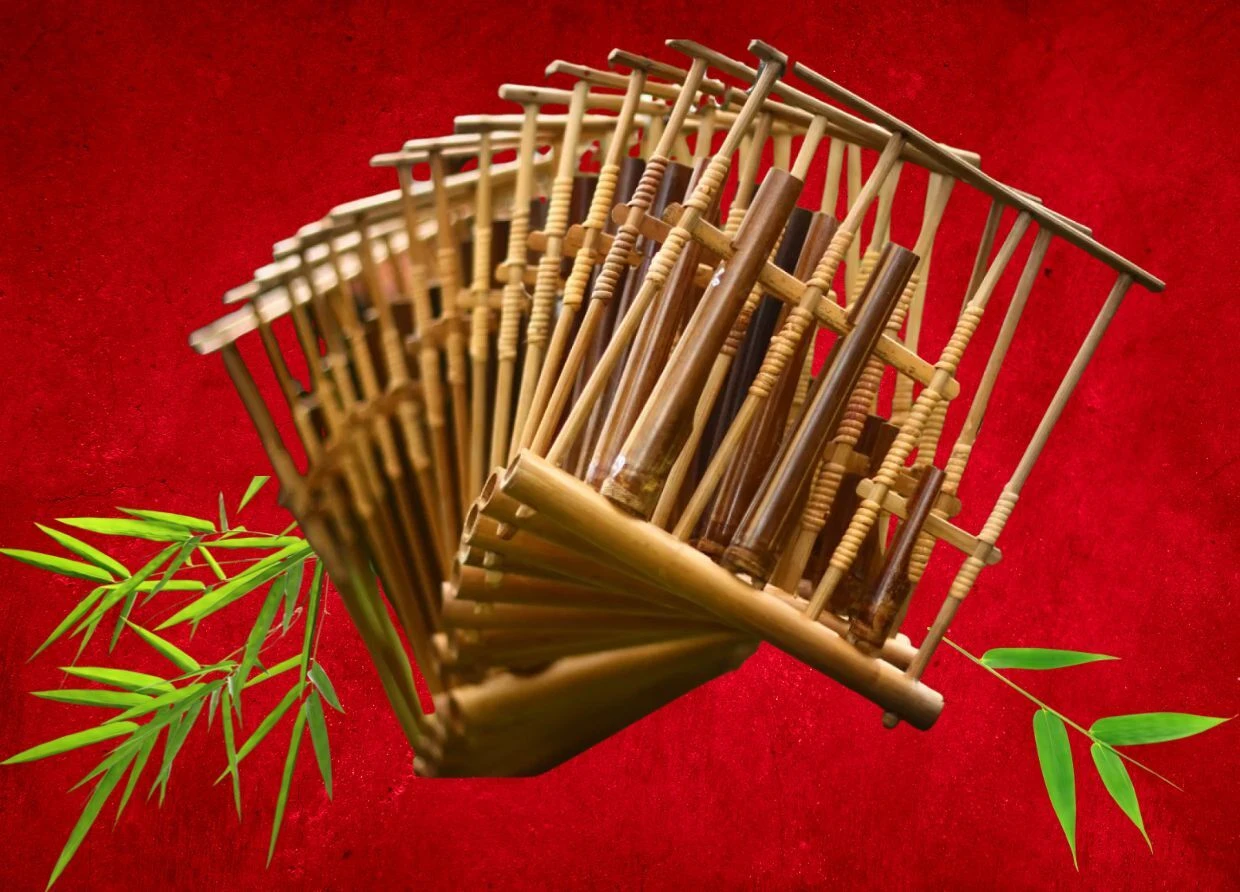
The angklung is the best-known example. This multitonal instrument comes from the Sundanese people of West Java and is made from bamboo tubes.
Each player shakes one angklung to make a bright, hollow note, so a group must play together to make a tune. UNESCO inscribed the angklung on its Representative List of the Intangible Cultural Heritage of Humanity in November 2010.
In the Indonesian Vibez photo, rows of players in black shirts stand shoulder to shoulder, each holding one instrument and waiting for their single note.
"Indonesia, the land of bamboo where nature grows into culture."
Indonesian Vibez, Instagram
Bamboo also moves. Kuda Kepang, a traditional Javanese dance, uses horse-shaped props made from woven bamboo. In Papua, the sisir Papua is a hair-grooming comb traditionally made from bamboo such as Bambusa vulgaris.
How old is bamboo in Indonesian history?
Here is the twist: bamboo is everywhere today, but it rarely shows up in archaeology. Because it is organic, it normally decomposes. At Situs Liyangan in Central Java, however, researchers documented charcoal remains of bamboo and wood inside an ancient settlement.
That gives us rare proof of the organic materials past communities used.
The word itself has a story too. "Bamboo" may have older roots in Tamil and Kannada, but it reached the wider world through the Malay world of the Nusantara. Portuguese and Dutch traders adopted it from Malay forms such as bambu and mambu.
So when the world says "bamboo," it is repeating a word that travelled through Malay.
The Instagram account Indonesian Vibez marked International Bamboo Day with a six-slide post that gathered these examples. Read together, they make one simple point. In Indonesia, bamboo is rarely just a plant. It is a bridge, a wall, a cooking pot and a musical instrument.
Next time you hear an angklung or see a woven wall, you will know what you are looking at.