TENUN TIDORE IS ALIVE AGAIN. BUT NOT WHERE YOU'D EXPECT.
Tenun Tidore, a traditional woven cloth from North Maluku that disappeared for a century, and debuted not at home, but in the heart of Germany.





One hundred years of silence. Then, a loom. Then, hands that remembered what history almost forgot.
Tenun Tidore a hand-woven textile from the island of Tidore in North Maluku had effectively ceased to exist for a full century. No living weaver was practicing it. No commercial market kept it alive. It survived only in archive photographs and fading institutional memory. Then a group of Indonesian women decided that wasn't good enough.
What Is Tenun Tidore ?
Tenun Tidore is a traditional hand-woven cloth originating from Tidore Island in North Maluku Province, eastern Indonesia. Part of a broader family of Indonesian tenun (woven textiles) that includes Tenun Tanimbar and Tenun Ikat, it is produced on a manual loom and carries geometric and cultural motifs specific to the Maluku region. Unlike batik, which is printed or stamped, tenun is woven thread by thread a process that can take weeks for a single piece. This particular textile had not been actively produced for approximately 100 years before its recent revival.
How Did It Come Back?
The revival came through painstaking research. The team behind the project tracked down archival photographs including images housed in actual archive offices to reconstruct the original motifs. One weaver in the documentary footage described the discomfort of seeing those motifs labeled and stored elsewhere, disconnected from the living culture they came from.
The comment carries weight: even the documentation of what survived had been filed under someone else's categorization.
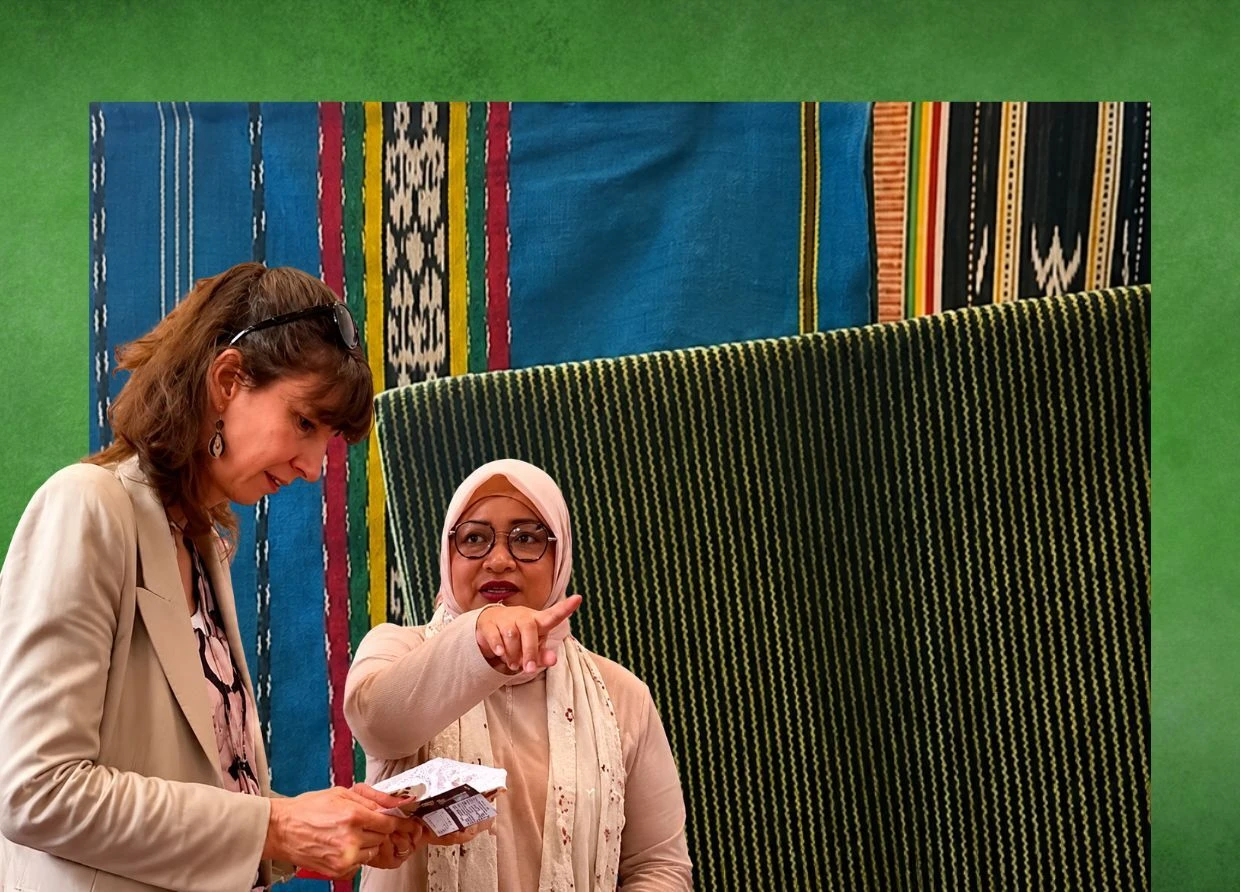
The fabric shown in the revival footage includes Tenun Tanimbar from Maluku deep olive greens layered with intricate dark geometric patterns alongside the vivid blue-and-multicolored striped textiles, all labeled and presented as culturally distinct pieces with clear regional identity.
Why Hamburg Before Jakarta?
This is where the story gets complicated — and honest. The DW Indonesia post documenting the revival and Hamburg showcase drew a pointed comment from user @lewajakarta: ("Shouldn't it be introduced to Indonesians in Indonesia first?")
It's a question without a clean answer. International exposure brings funding, legitimacy, and cultural exchange. But there's a particular irony in a textile that nearly died in Indonesia being celebrated first in Hamburg.
The counterintuitive truth about cultural preservation in Indonesia is this: global platforms often do more heavy lifting for local heritage than local institutions do. DW Indonesia the Indonesian-language arm of Germany's Deutsche Welle was the outlet that brought this story to 1,702 likes and 114 shares. Not a domestic broadcaster.
What This Means for Indonesian Craft
The revival of Tenun Tidore is part of a broader, urgent pattern. Dozens of Indonesian regional textiles are at risk of disappearing within a generation not from lack of beauty, but from lack of economic infrastructure, documentation, and visibility. Tenun Tanimbar, also shown at the Hamburg event, represents another Maluku tradition fighting for continuity.
The women behind this revival aren't hobbyists. They are researchers, practitioners, and cultural custodians operating with very little institutional support reconstructing techniques from archival images because no living teacher remained.
A thread, quite literally, back from the edge of nothing.