FIVE CENTURIES OF PRAYER: LARANTUKA'S EASTER LIKE NO OTHER
Every April, a small coastal town in East Nusa Tenggara draws 60,000 pilgrims to an Easter ritual older than Indonesia itself.





Every April, a small coastal town in East Nusa Tenggara stops the clock — and 60,000 people flood its streets, its sea, and its graveyards to relive a ritual that began before Indonesia existed.
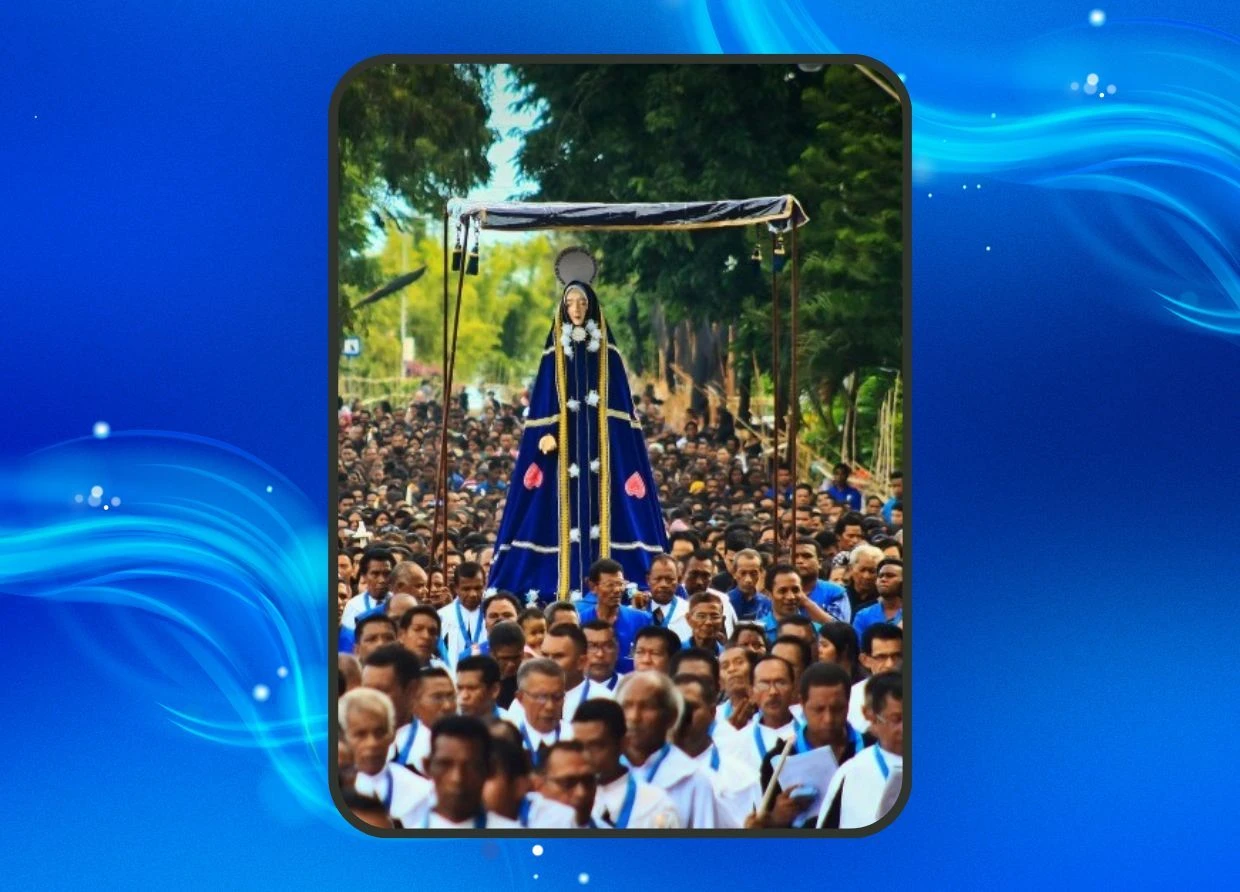
The procession doesn't walk — it moves like a tide. Thousands of people dressed in black and blue press shoulder-to-shoulder through the narrow streets of Larantuka, a town of roughly 30,000 on the eastern tip of Flores Island, East Nusa Tenggara. At the center, carried high above the crowd, is a wooden statue of a woman draped in blue robes. She arrived, according to local belief, not by human hands — but by the sea, more than 500 years ago.
This is Semana Santa, Indonesia's oldest and most extraordinary Easter tradition — and most Indonesians have never heard of it.
What is Semana Santa Larantuka?
Semana Santa — Portuguese for "Holy Week" — is a week-long Easter celebration held annually in Larantuka, the capital of East Flores Regency, Nusa Tenggara Timur. It blends Roman Catholic liturgy with the indigenous Lamaholot culture in a ritual that has been practiced continuously for over five centuries. The events run from Palm Sunday through Easter Sunday, culminating in a dramatic sea procession and candlelit night vigil on Good Friday. Attendance regularly exceeds 60,000 pilgrims, including visitors from Portugal, Brazil, and East Timor.
Where did this tradition come from?
It began with a mystery. Around 1510, Lamaholot fishermen discovered a carved wooden statue of a woman on the shore of Larantuka Beach. They had no knowledge of Catholicism. They called her Tuan Ma — Mother — and treated her as a sacred symbol of blessing, placing her in a worship house.
When Portuguese missionaries from the Dominican Order arrived in 1561, they recognized the statue as Maria Dolorosa, Our Lady of Sorrows. What followed was not a replacement of local belief — it was a fusion. The Lamaholot people already venerated her. The missionaries gave that devotion a structure. According to researcher Saferi Yohana in his study "Portuguese Representations in The Semana Santa Ritual in Larantuka," the tradition's roots trace directly to 16th-century Portuguese missionary contact.
What actually happens during the ceremony?
The celebrations open on Palm Sunday with a procession circling the cathedral — symbolizing Jesus's entry into Jerusalem. Throughout the week, ritual prayers, candlelight vigils, and community gatherings build in intensity. Special officers called Laka Demu wear robes that conceal their identities, carrying sacred statues through the city streets.
The peak is Good Friday. In the morning, the statue of Tuan Menino — the Child Jesus — is escorted across the Larantuka Strait by hundreds of boats, from small wooden canoes to larger ferries, in what's called the Perarakan Laut (Sea Procession). That night, the Sesta Vera vigil fills the town cemetery with thousands of glowing candles lit by pilgrims praying at the graves of priests and pastors.
Why has it survived for 500 years?
Anthropology lecturer Hipolitus Kristoforus Kewuel from Universitas Brawijaya puts it simply: a forced tradition has limits. What survives in Larantuka survived because it was never forced. It grew from the inside out — from the Lamaholot people's own relationship with the statue, long before any missionary arrived to name it.
The social glue is the Konfreria, a community organization that has managed and preserved the ritual for generations. Solidarity runs so deep here that non-Catholic neighbors help prepare the ceremonies and welcome pilgrims arriving from abroad.
Is this just a religious event, or something bigger?
It's both — and that's the point. What makes Semana Santa different from most Easter observances is that it isn't only a religious obligation. It's identity. Children grow up watching, then participating, then one day carrying the statue themselves. The tradition passes not through instruction but through lived experience.
As Hipolitus notes: Easter in Larantuka is different because it isn't just a celebration of faith — it's a living cultural inheritance.